
Iran
The Largest Untapped Agricultural Market for U.S. Exporters
Why now is the time to prepare
Executive Summary
While the political path to renewed U.S.- Iran trade is unclear, its import dependency is not.
Iran's agricultural policy faces a contradiction it cannot resolve: a self-sufficiency mandate it is politically unable to abandon and demonstrably unable to fulfill.
The result is deep, structural demand for foreign agricultural commodities, equipment, inputs, and technology.
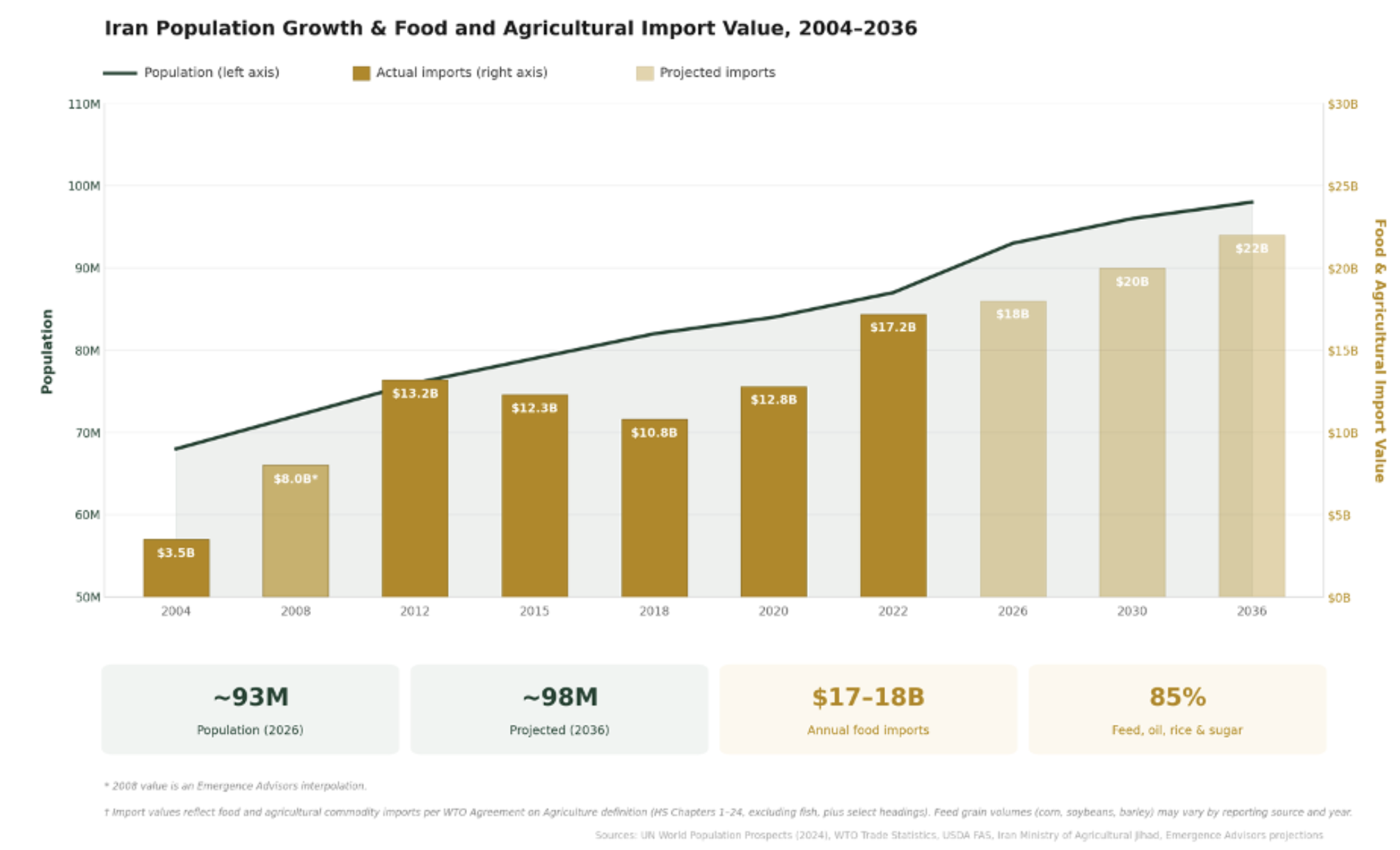
That demand currently represents $17-18 billion in annual foreign currency allocation for food and feed alone, projected to reach $20 billion by 2030.
Emergence Advisors provides the intelligence U.S. agricultural companies need to be ready to compete when the trade window opens.
A market that policy cannot eliminate
“Agriculture is organized as if water, soil, and productivity constraints play no role in decision-making.”
Mohammad Emami
Deputy Director of Research
National Center for Agricultural and Water Studies of Iran [in Persian]
January 7, 2026
Iran’s strategic potential: Why now is the right time to prepare
The future of U.S.-Iran relations is unclear.
But across the range of plausible outcomes are scenarios that significantly expand U.S. trade opportunities in Iran, and companies that prepare now preserve the option to move the moment conditions allow.
When sanctions were partially lifted under the JCPOA, Iran's GDP grew 12.5% in 2016, its only double-digit growth in decades.
Iran's demand was present even under Maximum Pressure.
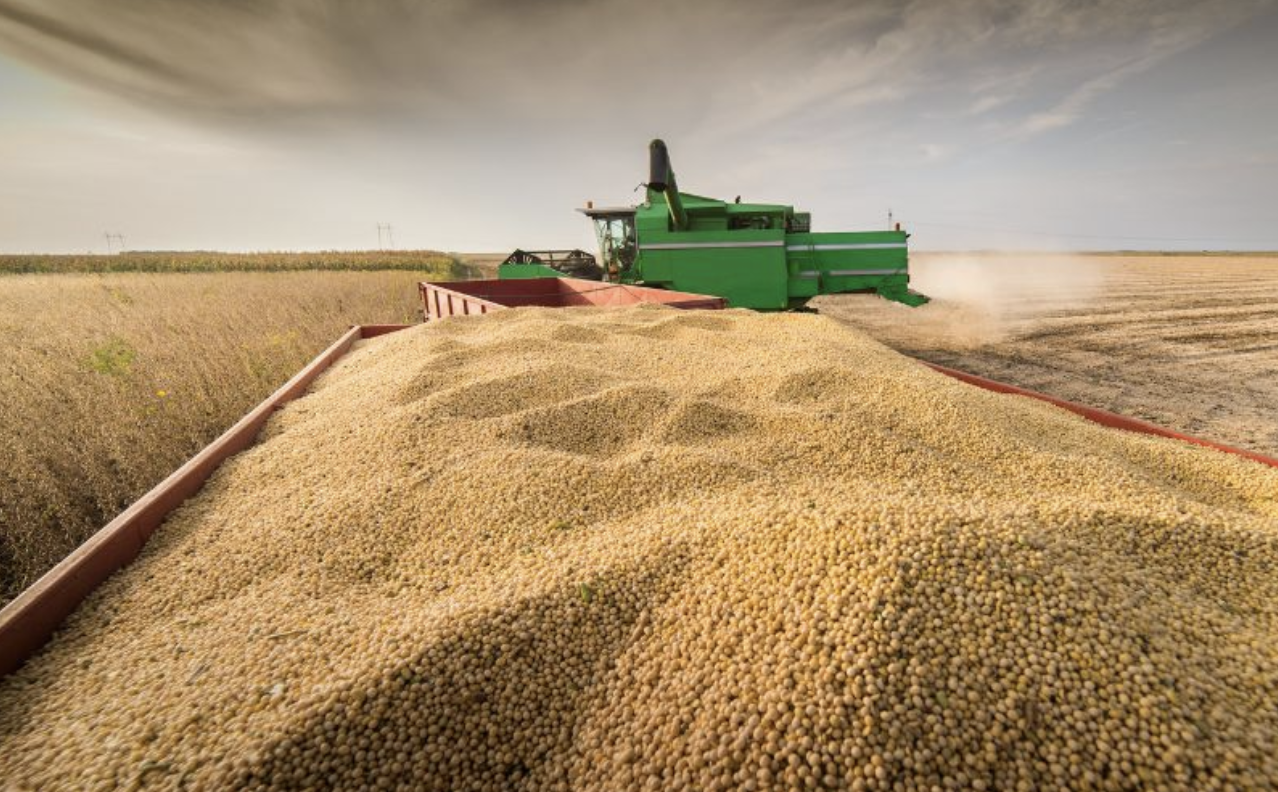
U.S. soybeans became price-competitive in 2018 during the U.S.-China trade dispute, leading to Tehran importing nearly 900,000 metric tons of U.S. soybeans in a matter of months, while navigating sanctions, banking restrictions, and shipping issues.
Market Overview
For U.S. agriculture companies and producers, Iran represents the largest untapped agricultural import market in the world, spanning commodities, equipment, inputs, and technology.
Despite decades pursuing agricultural self-sufficiency, Iran remains deeply and structurally dependent on imported food and commodities due to water scarcity, declining soil productivity, rapid urbanization, and a technology gap widened for decades by sanctions.
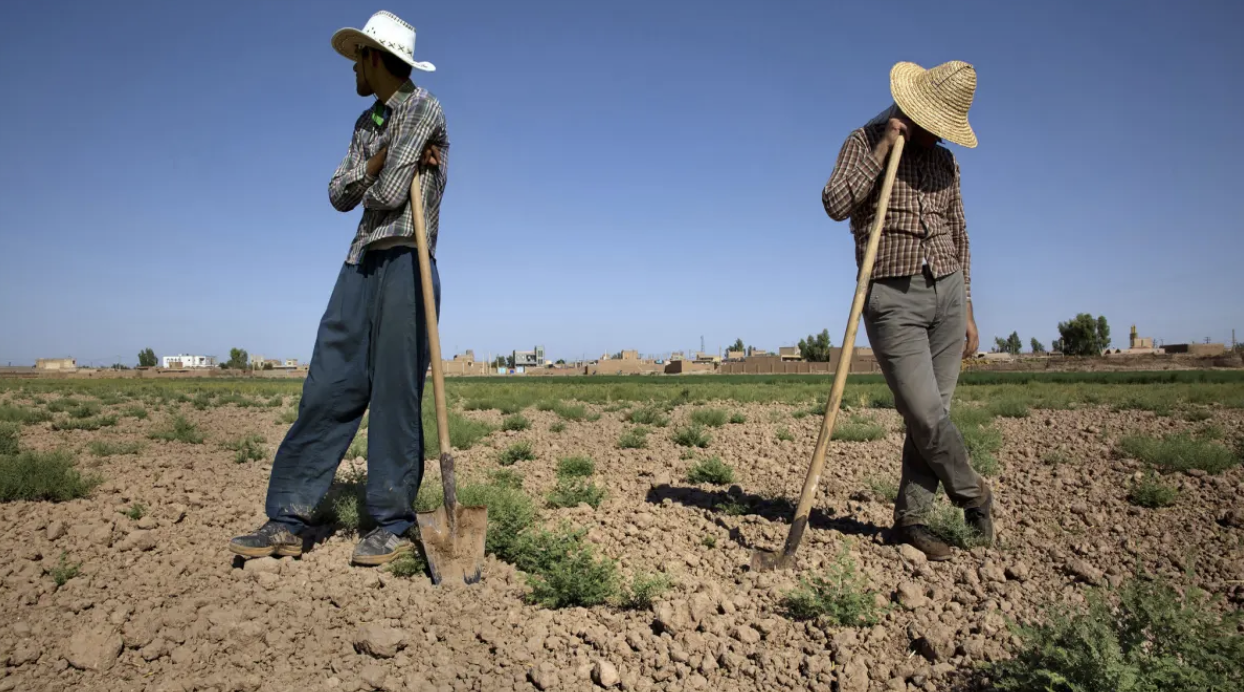
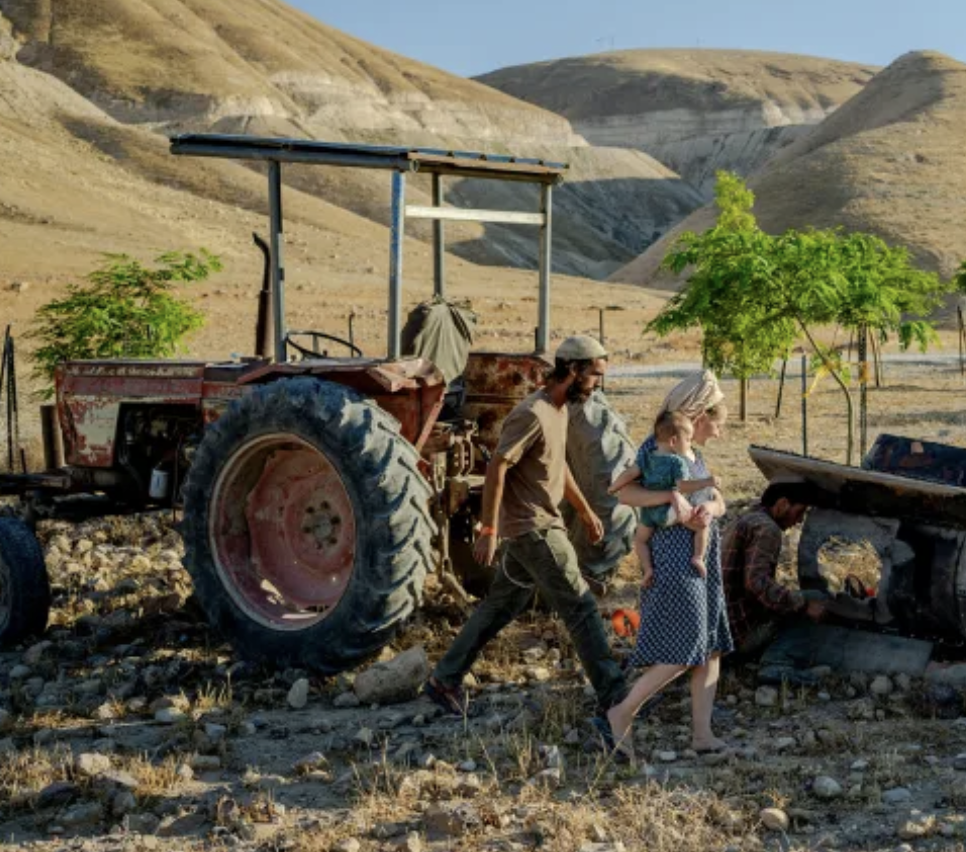
Half of Iran’s active tractor fleet requires replacement, soil nutrient depletion has reached critical levels in major agricultural provinces, and modern irrigation systems cover fewer than 40% of Iran’s irrigated farmlands.
Precision agriculture, high-yield seed varieties, and crop protection technologies that are standard in competitive markets remain largely inaccessible.
Half of Iran’s active tractors need replacement
“One in two tractors still operating in Iran has exceeded its useful service life, an estimated 320,000 to 330,000 units.”
Hamid Reza Nami
Chairman, Agricultural Machinery Manufacturers Association
Jahan-e Sanat [in Persian]
August 30, 2025
Iran's food and agricultural imports have grown nearly fivefold since 2004, not only because of policy choices, but also due to structural realities.
The forward projections assume none of these conditions improve, a conservative assumption that Iran's own agricultural research establishment supports.
Food or Shelter
“Families are choosing between food and shelter not out of preference, but out of necessity - and the choice is usually resolved in favor of the lease.”
Nour News
December 25, 2025
Nour News is the official mouthpiece of Iran's Supreme National Security Council
Food basket demand: Quantifying the addressable market
Iran's agriculture policy is a national security issue.
The government's inability to provide affordable food is a fundamental weakness. Demonstrating the acute challenge, on December 28, 2025, protests erupted across Iran, spreading within days to all 31 provinces.
The trigger was the elimination of the preferential exchange rate that had subsidized essential food imports.
One week into the unrest, Iran's Minister of Agricultural Jihad announced a direct subsidy to cover approximately 75% of the cost of a basic monthly food basket - the minimum required to feed one person.
Data drawn from Iran's official economic reporting body and published in Iranian financial media showed food costs were nearly four times the value of the subsidy itself.
Emergence Advisors estimates, based on the Iranian government's own statements and data, that the import-dependent portion of Iran's food requirement is approximately $1.8–2.0 billion annually.
That figure covers the household food basket alone.
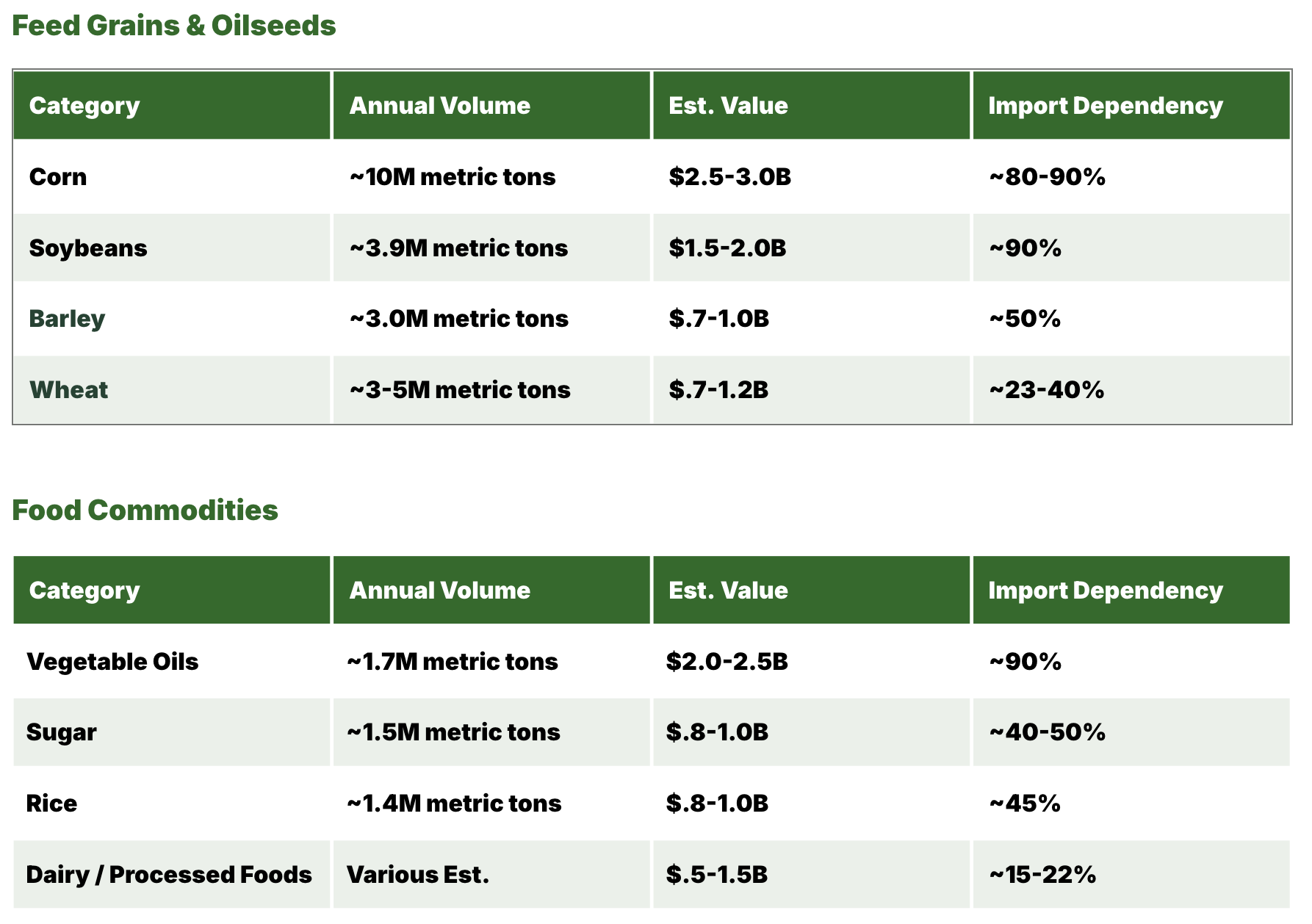
When combined with feed grain and oilseed imports - the commodities that underpin Iran's livestock and poultry sectors - total U.S.-competitive agricultural import demand reaches approximately $5.6 billion annually, as detailed in the tables below.
A return to internationally recognized nutritional standards across Iran's population would add billions of dollars in additional annual food import demand that Iran's domestic production cannot meet.
Demand across the supply chain
The commodity import figures alone understate the full scope of U.S. competitive opportunity in Iran.
A trade opening would unlock an integrated agricultural supply chain opportunity across seeds, irrigation technology, equipment, and inputs that Iran cannot supply domestically at the scale or quality its agricultural sector requires.
While some estimates place Iran's seed market at $184 million annually, the actual opportunity is larger.
The government supplies only 30% of the one million tons of certified seed required nationally - drought reduced even that supply by 57% in 2025. At Ministry-certified prices of approximately $400 per ton, the 700,000-ton annual certified seed gap represents approximately $280 million for wheat and barley alone.
Iran has equipped approximately 3.1 million of its 8.5 million irrigated hectares with modern systems.
The remaining 5.4 million hectares (13.3 million acres) are reliant on legacy methods that exacerbate its water crisis.
At $800–$1,400 per acre, the total capital gap represents $10–18 billion in unmet investment. The government current funding rate (~$193 million annually) will require decades to close the gap.
Beyond mechanization, seeds, and irrigation, Iran's agricultural supply chain presents additional import-dependent opportunities across animal genetics and breeding technology, cold chain and post-harvest processing infrastructure, crop protection inputs, and precision agriculture systems - each representing documented demand that sanctions have suppressed but not eliminated.
Import composition: Where Iran’s dollars go
The tables below detail where Iran's agricultural import dollars go. The categories where U.S. exporters hold competitive advantages - feed grains, oilseeds, and food commodities Iran cannot produce at scale - represent approximately $5.6 billion in annual import demand.
This is Emergence Advisors' estimate of the commercially actionable market for U.S. agriculture, based on Iran's domestic production constraints.
Multiple value streams for U.S. agriculture companies
The Iran opportunity is not limited to commodity exports.
For U.S. agricultural companies willing to think strategically, Iran offers multiple distinct value streams - each independently significant, collectively transformative.
Selling into Iran
The $5.6 billion annually in U.S.-competitive commodity demand documented above is the floor, not the ceiling. Input, equipment, technology, and logistics opportunities add billions more.
Establishing market knowledge and regulatory familiarity will position companies to move immediately when conditions allow.
Logistics and transit efficiency
Iran sits at the intersection of developing north-south and east-west international trade corridors. U.S. companies that establish Iranian logistics relationships gain corridor access - reducing transit costs and times for product moving between Central Asia, the Gulf, and European markets, that competitors routing through Russia or China cannot match.
Sourcing from Iran
Iran produces commodities that U.S. companies currently source from other markets at higher cost. Iran is one of the world's two largest pistachio producers and supplies roughly 90% of global saffron.
Its fisheries, dried fruit, and specialty agricultural sectors represent sourcing opportunities for U.S. food manufacturers and ingredient companies that currently use less efficient supply chains.
Investment and joint venture
Iran's domestic agricultural manufacturing base - tractors, processing equipment, grain handling - and its world-class STEM workforce create joint venture opportunities for U.S. companies seeking regional manufacturing platforms.
Equipment produced in Iran under U.S. technology licensing could serve markets across the region at cost structures unavailable from U.S. domestic production.
Primary sources. Cultural understanding. Ongoing research.
Emergence Advisors sources its Iran market intelligence directly from Persian-language publications - government ministries, state news agencies, trade associations, and provincial agricultural organizations.
We focus our research on Ministry of Agricultural Jihad officials at the national, provincial, and local level, private industry, trade associations, and the Chamber of Commerce.
We bring decades of experience on Iran to interpreting and understanding the nuances in communication; the political and cultural dimensions that shape how information is framed and what it actually means.
Applying our experience and analytic rigor, we are able to fuse information to gain insight into what is occurring within Iranian agriculture - not just what the government or industry wants to project.